








Reporting materials:
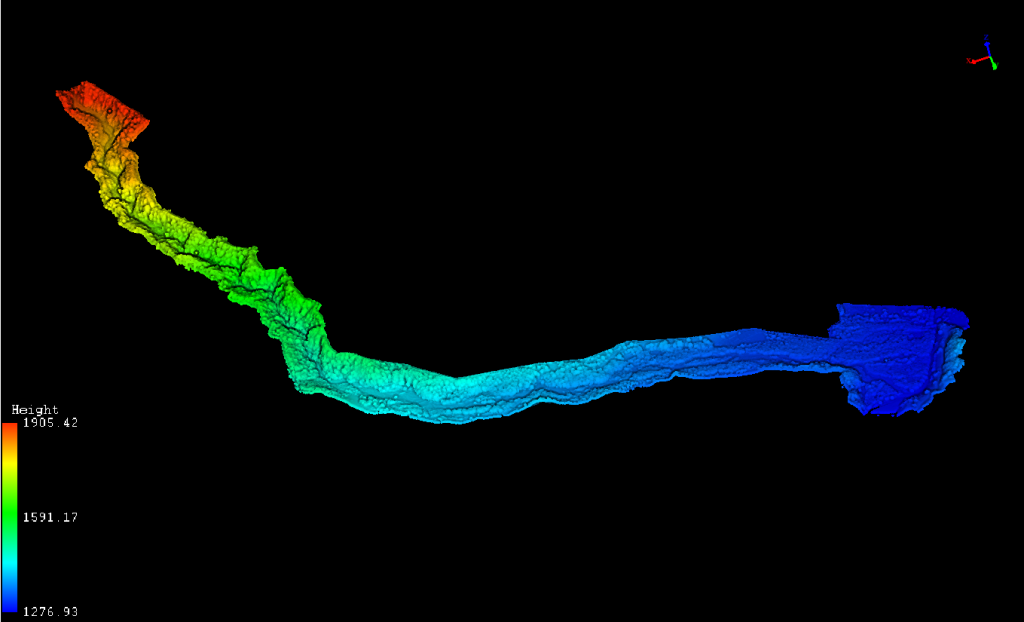
Orthomosaic, 3D terrain model, Classified point cloud, Digital Elevation Model (DEM).
Equipment:
- TOPODRONE DJI Mavic 2 Pro PPK
- DJI Matrice 300 with TOPODRONE LiDAR 100 LITE on board.
Terms and scope of work:
Total length – 6 km, corridor – 200 m, total area – 120 Ha.
Shortest terms of work - 1 day.
Flight preparation
All flights were planned and implemented using the UgCS Pro software, which provides planning for airborne laser scanning (ALS) and aerial photo survey (APS) missions, using the terrain following mode especially in the absence of the Internet.
For ALS we have created 2 linear missions of 3 km each and 1 areal mission and 4 missions for aerial photography have been prepared.
After receiving of the site central axis from the Contractor, the .kmz file was loaded into UgCS Pro software and the flight missions were created using this line as a background contour.
Unfortunately, we were not able to manage to go for a preliminary site check, because each time the weather conditions interfered, and there was less and less time before the shooting, so when we saw a satisfactory weather forecast, it was decided to go and shoot right away.
Of course, taking into account that we didn’t know the site conditions, some of the missions were changed directly in the field.
Also, very important problem for Aerial survey in Georgia is mountainous relief, consequently – total and permanent loss of the signal between drone and remote controller during the flight, that’s why all the missions were planned with “Continue flight” option.
In this case, the signal was lost after about 5 minutes from the start of the flight, periodically appeared when the drone approached the takeoff point and was lost again.
In the case of the DJI M300, the signal was lost after overcoming the first mountain and appeared when the drone has already landed.
However, generally, I would like to underline that the DJI M300, with its set of sensors, is a very fault-tolerant copter, since more than once in conditions of complete absence of a signal, when an obstacle was detected, it always returned safe and sound.
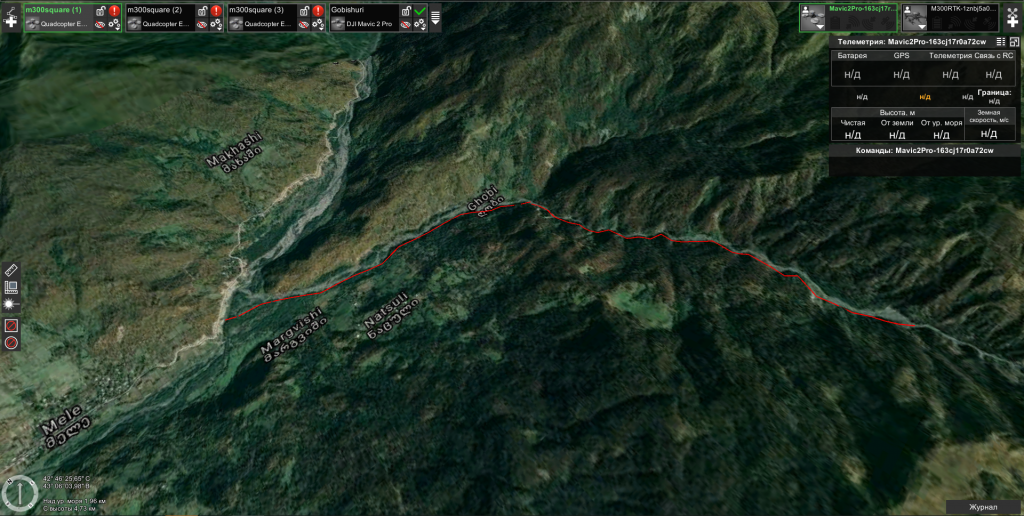
Pic. 1. Central line.
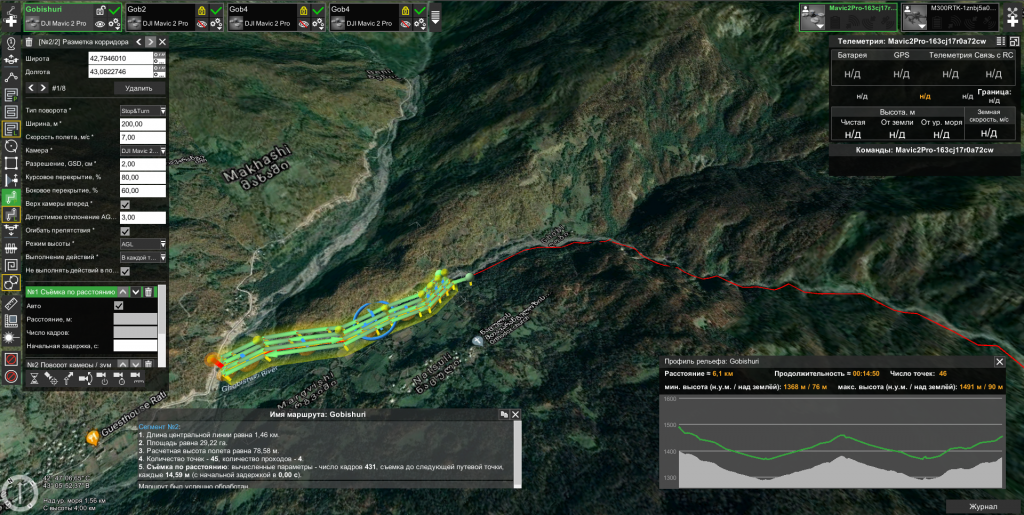
Pic. 2. Mission 1 for APS.
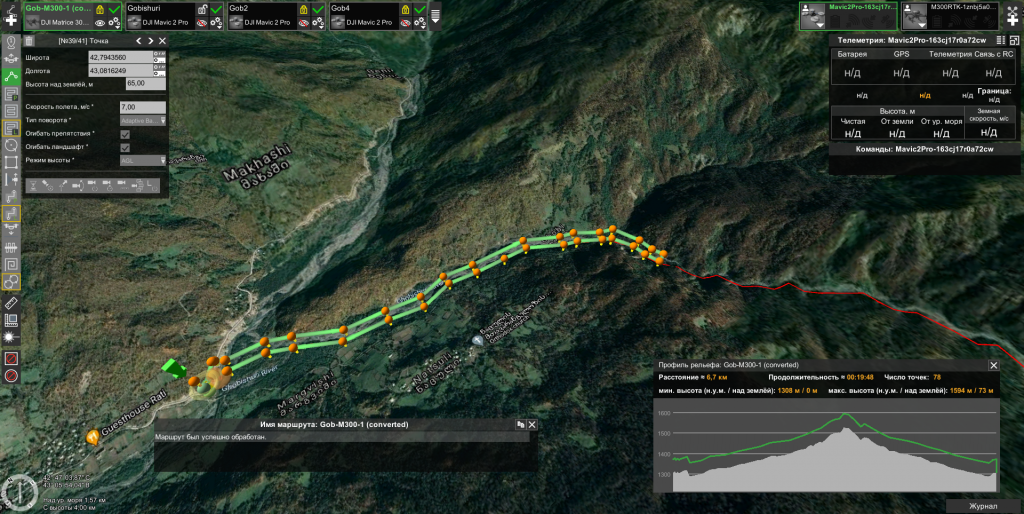
Pic. 3. Mission 1 for ALS.
Survey
We arrived at the site in the evening, hoping to at least study the area a little bit, but we failed to do this, the gorge makes a turn after 2 km from the starting point and it was not possible to see anything.
And as it is getting dark early in the mountains, by the time we arrived at the starting point (about 17:20), it was unrealistic to inspect the area. Only snow-covered peaks illuminated by sunset were visible at that time.
Since we were already on the spot, in order not to waste a time, we have decided to make the first flight of the M300 + LiDAR.
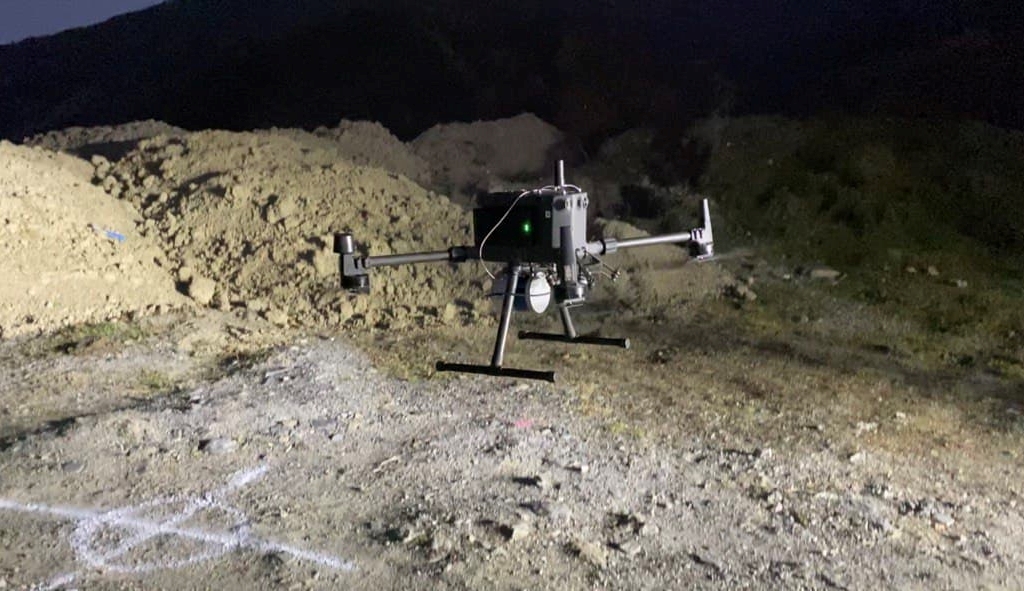
Pic. 4. Night ALS.
Flight was completed successfully and the first 3 km section was finished. It was a last time when we didn’t lose the signal.
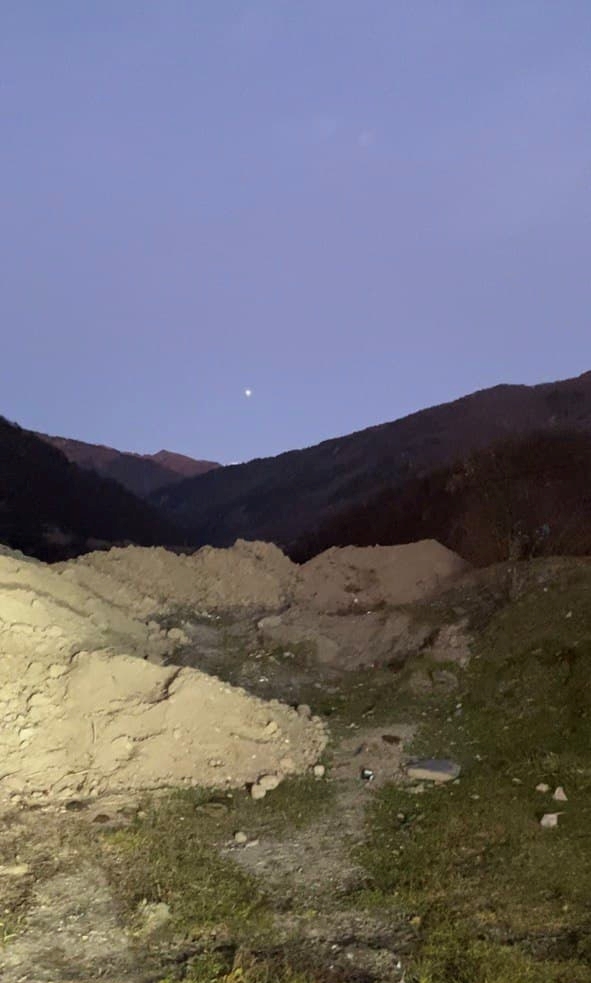
Pic. 5. It’s not a star, it’s a DJI M300 + TOPODRONE LiDAR 100 LITE
The second day was started early morning. Along the whole site central axis, we have prepared the GCP’s, where it was accessible, also the mission plans for the 1-st section were revised and we started the shooting. Despite the fact that the 1st flight was successful, for the second flight strength of wind has increased, so the mission had to be split up due to a lack of charge. Furthermore, an additional problem was that the sun practically did not show out from behind of the mountain, so, only half of the gorge was illuminated.
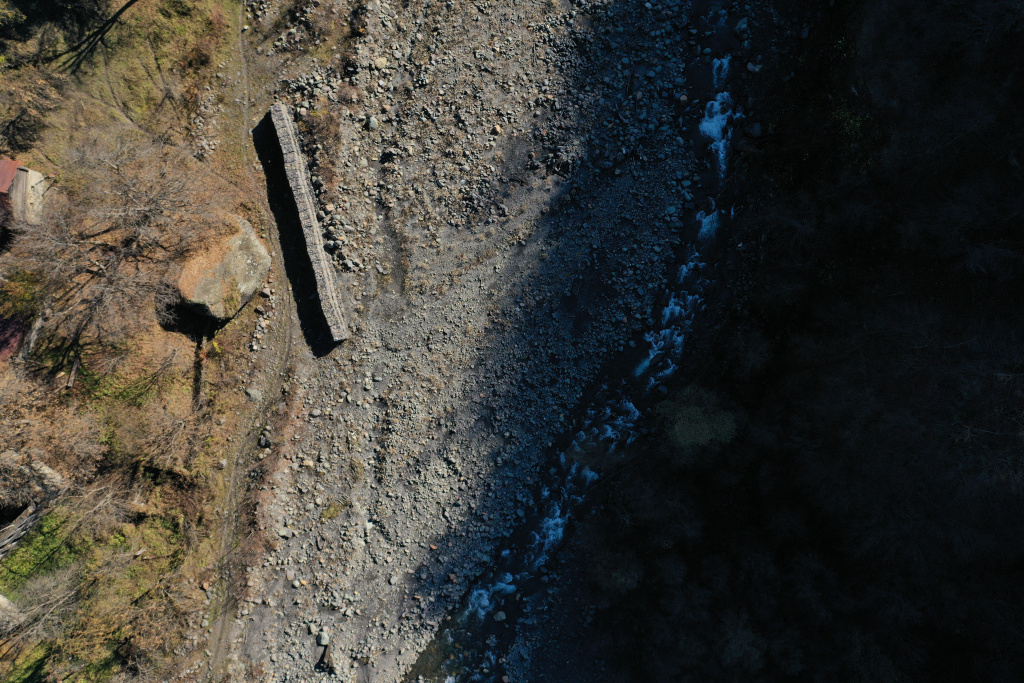
Pic. 6. Illumination problem.
And as the shooting continued, the number of lights was gradually decreased. Moreover, we only had a half of the sun light at our disposal by noon, around 2:00 pm the sun began to retreat back over the mountain. Therefore, it was decided to finish the APS first and only then perform ALS.
Due to the reliability of the equipment and the ability to perform work without a direct connection between the R/C and the drone, we managed to complete everything before dusk.
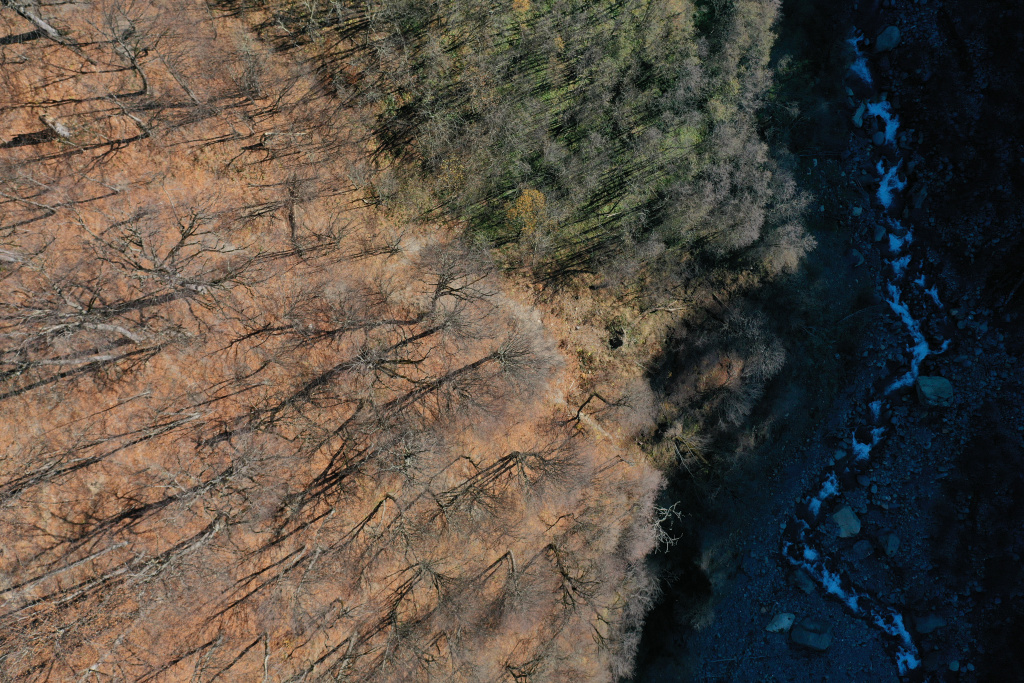
Pic. 7. Sunset.
I would like mention here that, luckily for us, TOPODRONE LiDAR 100 LITE doesn’t depend on illumination and allows to perform the ALS even at night.
Of course, it’s always a bit scary and risky to fly at night time with zero visibility, because the equipment is pretty expensive.
In case of a miscalculation in the mission or other variable errors, it will simply not be possible to correct the situation by the intervention of the operator in a site survey and the only one possibility to search for the copter, in the worst case scenario, to do it in the morning next day. On the other hand, the M300 has already established itself as a reliable drone in emergency cases, which you can rely on, including - at night.
Finally, M300 started the 2-nd section, after ~5 minutes we lost the connection, but surprisingly, the signal appeared very quickly, the drone was in RTH mode and heading to the takeoff point. As it turned out later, it was desperately trying to avoid a crash with a rock, which turned out to be in a very unfortunate location in the gorge, in the most inaccessible and invisible place.
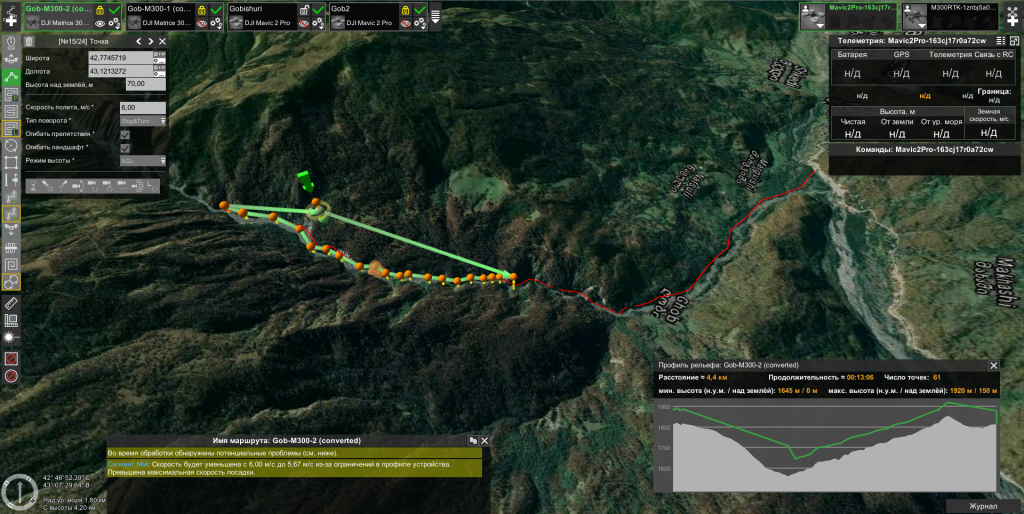
Pic. 8. LiDAR 2nd mission – edited.
We also encountered some issues during the uploading a mission to the drone - without an Internet connection it was impossible to upload a mission to the copter, for some reason, so we had to catch the Internet signal in conditions where even the GSM signal was completely absent. However, this issue was also resolved, as it’s shown on the photo above.
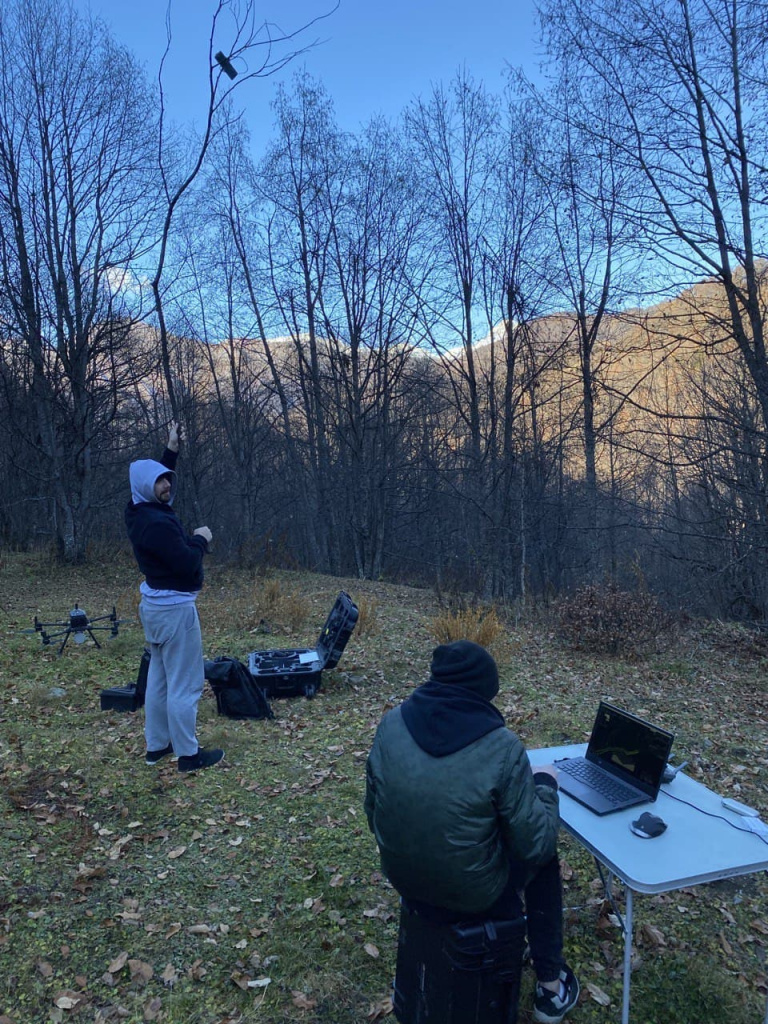
Pic. 9. Catching the Internet.
Once the flight mission was edited, I’ve deleted the completed part of the flight and after M300 was launched to finalize the section. Of course, it lost the connection with R/C after a couple of minutes since takeoff.
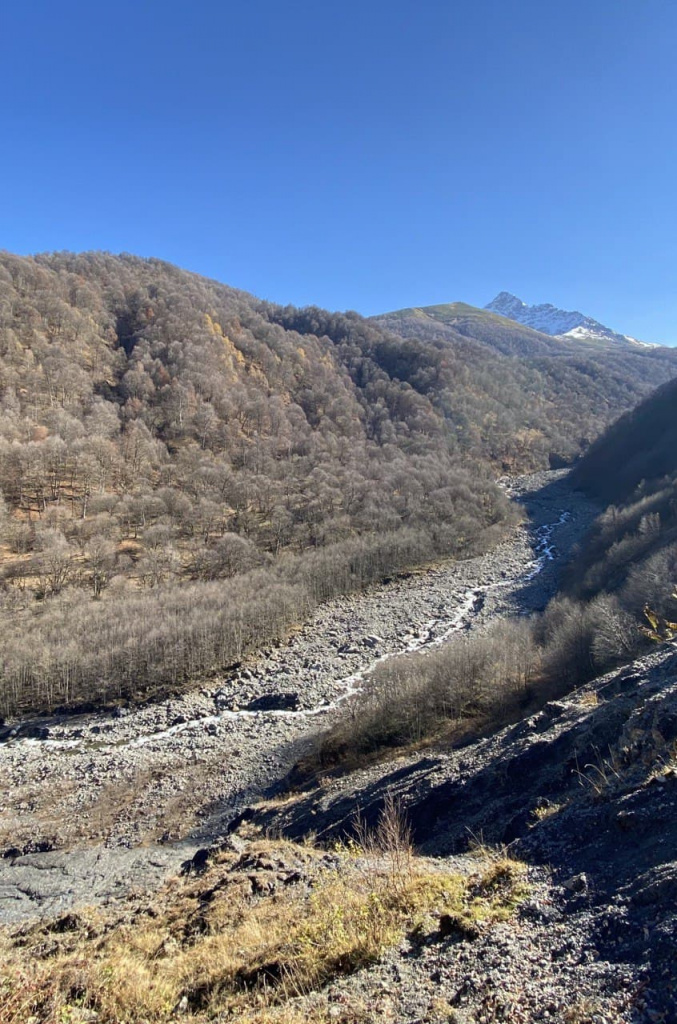
Pic. 10. Survey completed.
Survey specialist from Contractor’s side, who was joining us during the shooting period, asked to make a corridor wider at the starting point area. Since that, we were heading to start point to perform another one-night mission and get back home.
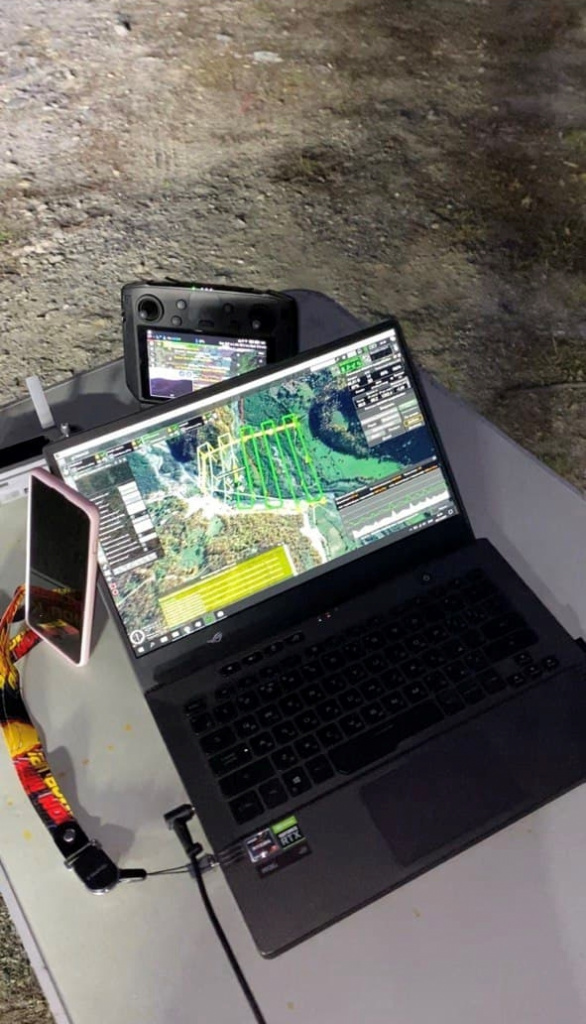
Pic. 11. Final flight.
Final flight was successful and quick, with no signal losses or any other stressful, but working situations.
Post-processing
Let’s start with processing APS data. So, we have performed 4 flights, 1.5 – 1.6 km each, with overlap:
- Longitudinal – 80%
- Cross – 60%
On average, each flight dataset contains from 400 to 500 images. Processing was carried out on .rinex files obtained from the reference network of base stations and on the Georgian quasi-geoid, since EGM2008 gives a very large height mistake.
All photos were processed in TOPOSETTER software. In just a couple of mouse clicks, using batch processing, high-precision photo centers were calculated for the entire volume of images, taken with TOPODRONE DJI Mavic 2 Pro PPK.
After TOPOSETTER processing it is possible to begin the photogrammetric processing, in our case it is an Agisoft Metashape software.
The whole dataset was separated on 4 blocks – 2 flights per 1 section of the working site. Again we’ve used the batch processing for time economy - while Agisoft Metashape was aligning the images, trajectories and point clouds were being calculated in TOPODRONE Post Processing.
So, the images are aligned, the camera is calibrated, it is possible to start working with the Ground Control Points (GSPs).
We prepared 20 GCPs, 14 – were intended for the APS and 6 additional ones for checking the accuracy of the ALS.
According to the accuracy of the photography centers, the values vary from 3 cm to 6 cm, according to the data of the reference and control points - within 2.7 cm.
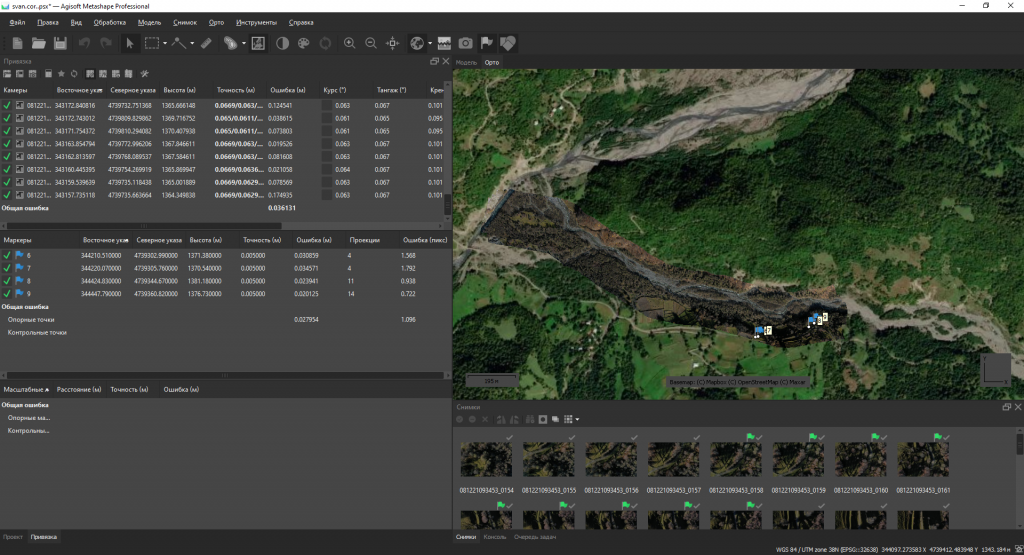
Pic. 12. GCP and PC accuracy.
Of course, the accuracy was different on the section areas, first of all, the lighting changed quickly, and second, the surface on which the control points were created was far from an ideal.
However, the data is high quality and the accuracy is high as well, so we turn on batch processing to create orthomosaic and proceed to ALS processing.
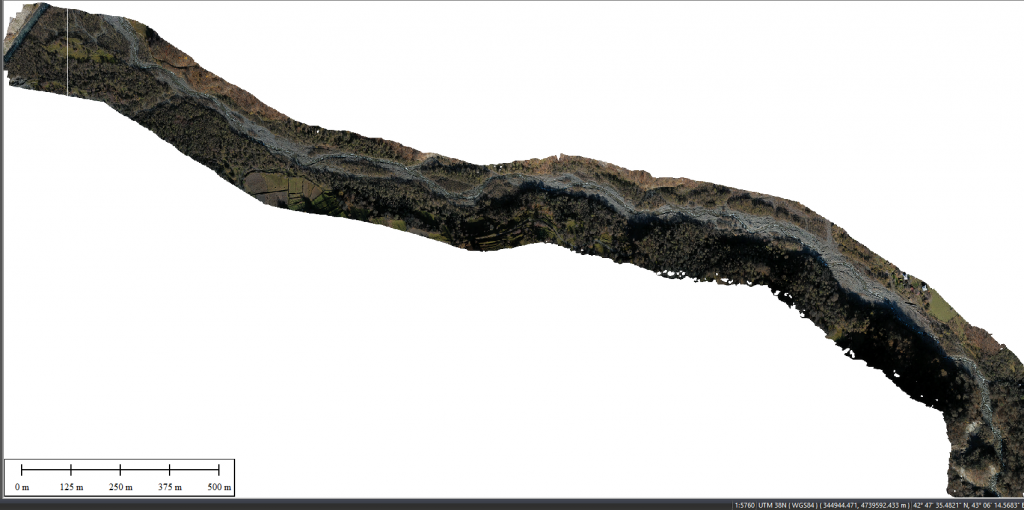
Pic. 13. Orthomosaic – main view.
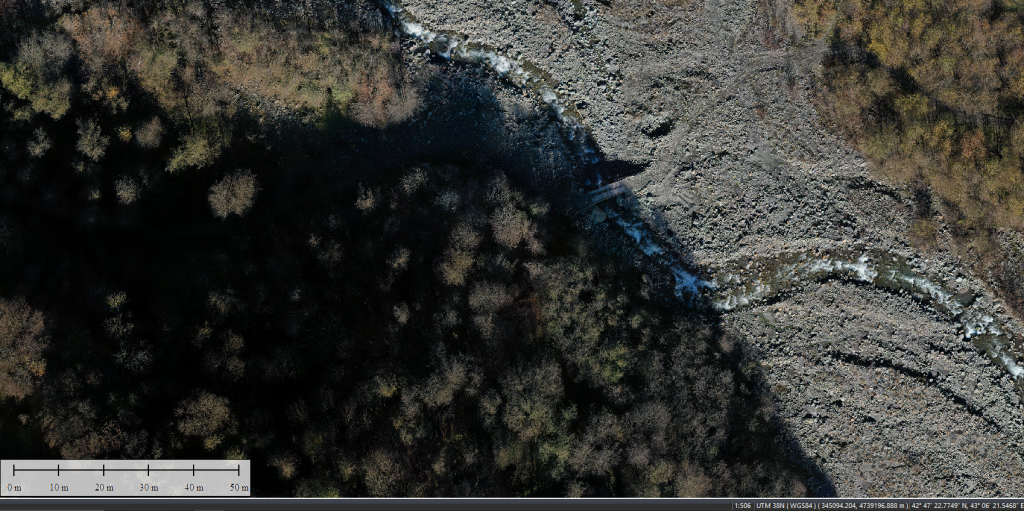
Pic. 14. Bridge.
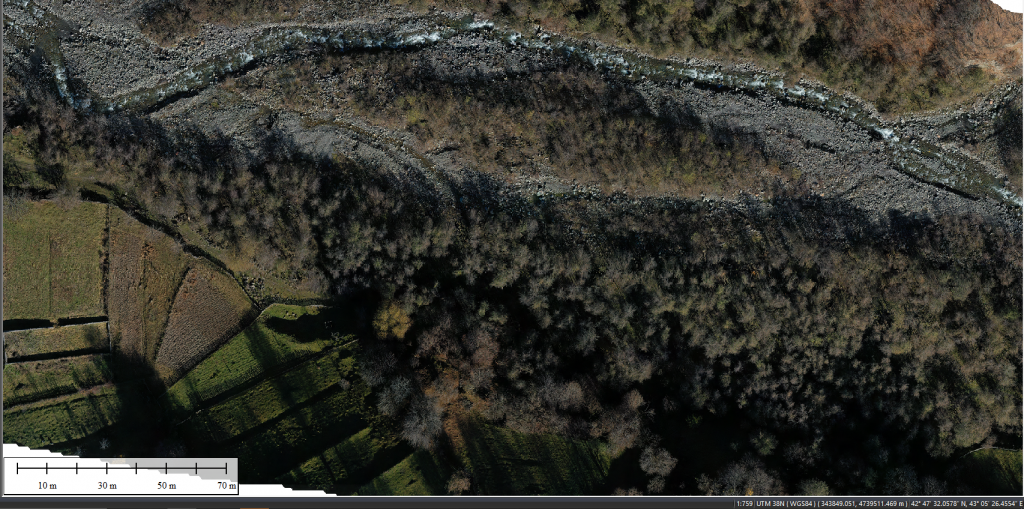
Pic. 15. Orthomosaic.
Volume of ALS data is much less, only 3 flights and, consequently – 3 point clouds. For ALS, we did not split the data into sections and provided the Contractor with all 6 km of the gorge.
Once we get dense point cloud from TOPODRONE Post Processing, it is possible to continue pot-processing in LiDAR360 software. What was requested by the Contractor?
-
Unite 3 point clouds to get a general view.
- Verify that, the Z axis accuracy values are correct.
- Classify the point cloud to select the Ground layer.
- Produce the surface contour lines with a step of 15 m.
- Extract a set of points in .csv format with a step of 15 - 10 - 5 - 3 m.
So, proceeding step by step, uniting the point clouds – after processing we obtain a .laz point cloud. Each cloud is being processed separately:
- Loading the trajectory file
- Separating the cloud on scans
- Calculating the Roll, Pitch, Heading angles.
- Control Point report
After these steps, we obtain correct point cloud, which is ready for further processing.
However, beautiful point cloud isn’t a final step, the main checking which should be produced before any further processing and manipulations is an accuracy control.
Using a “Control Point Report” function and a .txt file containing precise GCP coordinates we’re starting checking and report generation.
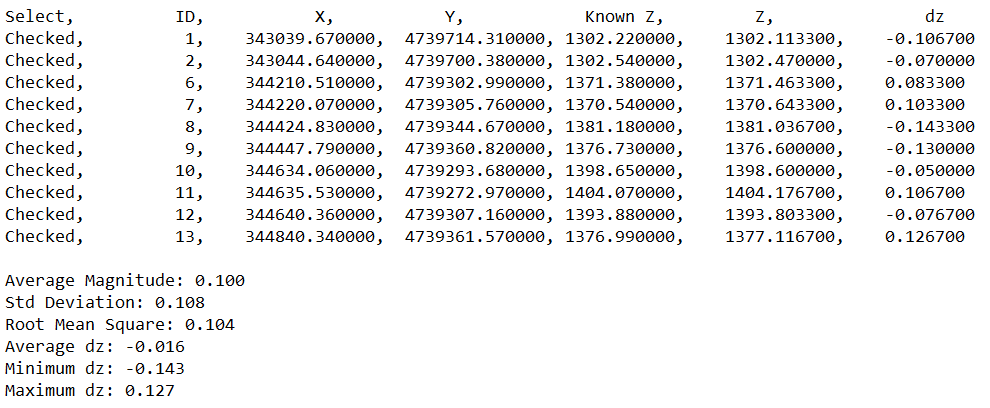
Pic. 16. Primary accuracy check.
According to the control point report, it becomes clear that there is a minor difference between calculated and real GCPs coordinates. This difference is acceptable, especially taking into account the relief and surface where the GCPs were created.
In this case it is possible to use “Elevation Adjustment” function, which meaning is to “lay” the generated point cloud on the correct coordinates, thereby minimizing the resulting error in Z accuracy.
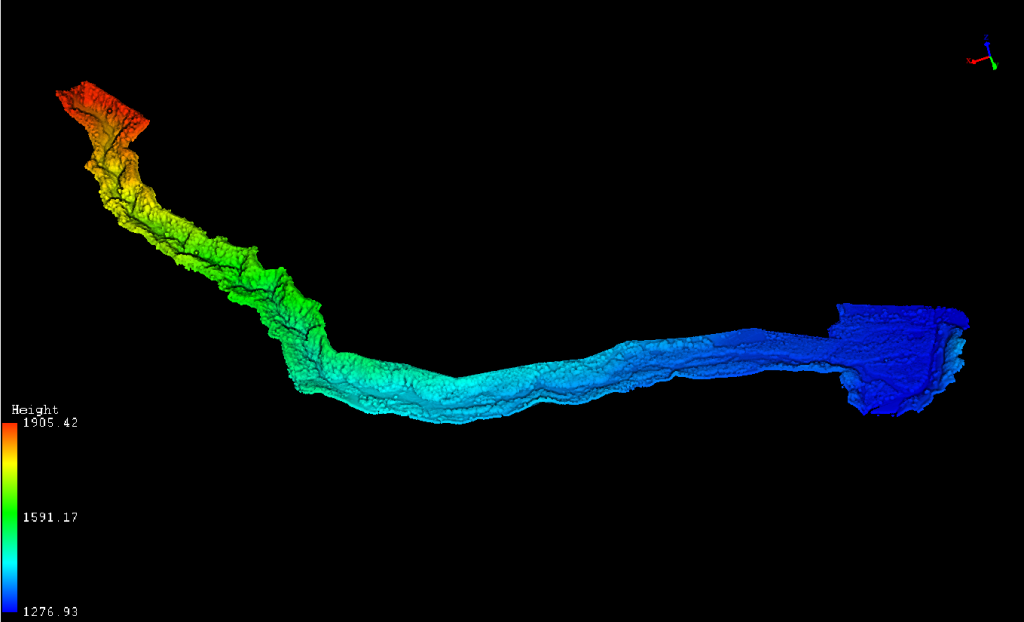
Pic. 17. Prepared point cloud.
Turning on the “Profile View” and checking the point cloud.
Along with accuracy, it is also interesting to test the penetrating power of the LiDAR. In particular, were the laser beams able to break through the crowns of trees and get to the surface of the earth, because otherwise the measurements taken would not be accurate.
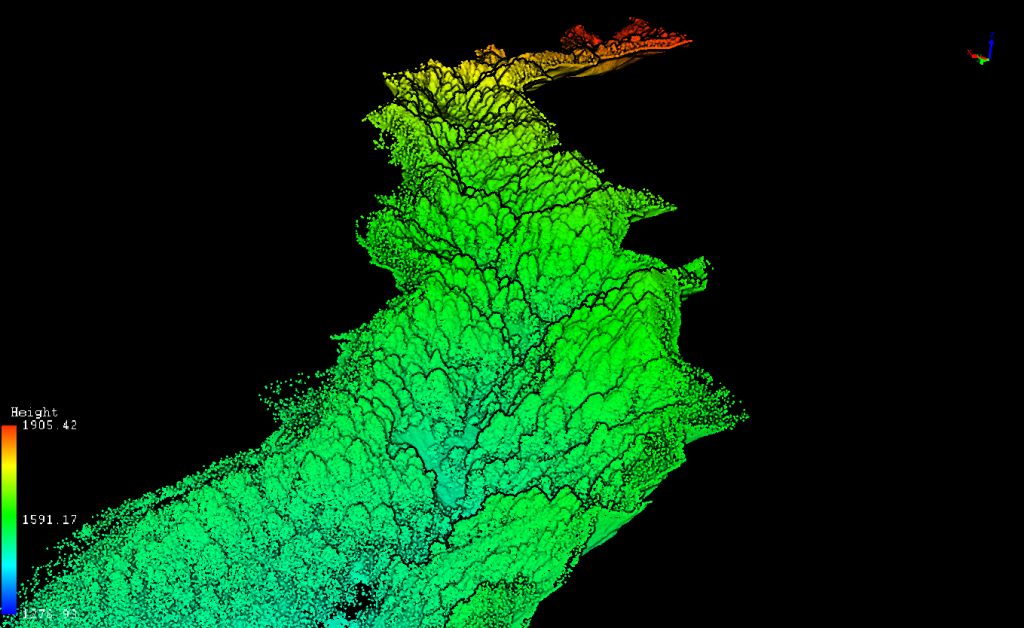
Pic. 18. Vegetation.
As it is shown on the Pic.18, the vegetation in this gorge is very dense, in some places on the slope it is not possible to go down on foot. That was one of the reasons why we weren’t able to took the GCPs all over the site central line.
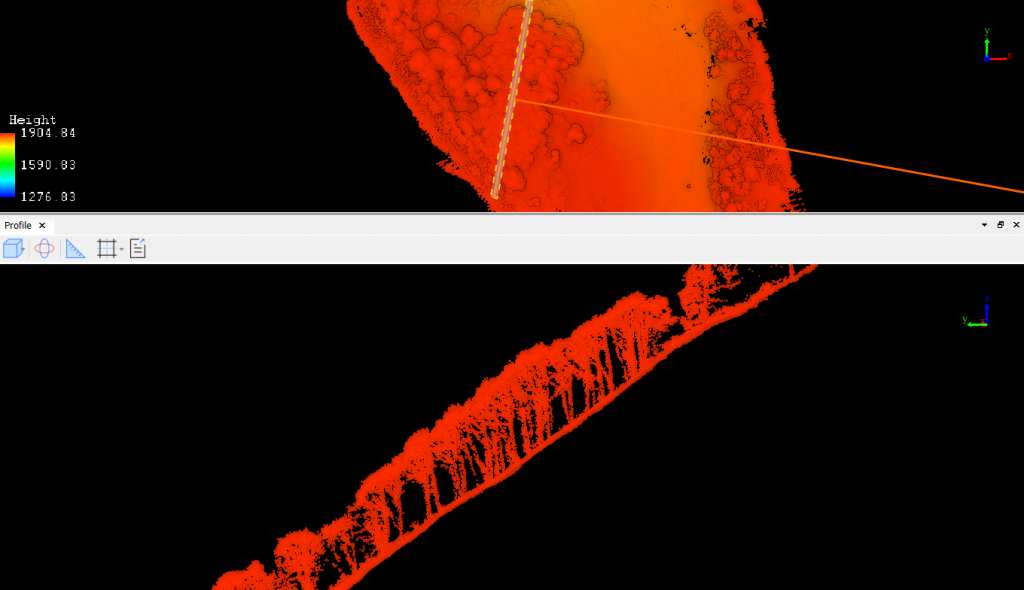
Pic. 19. Forestry surface profile.
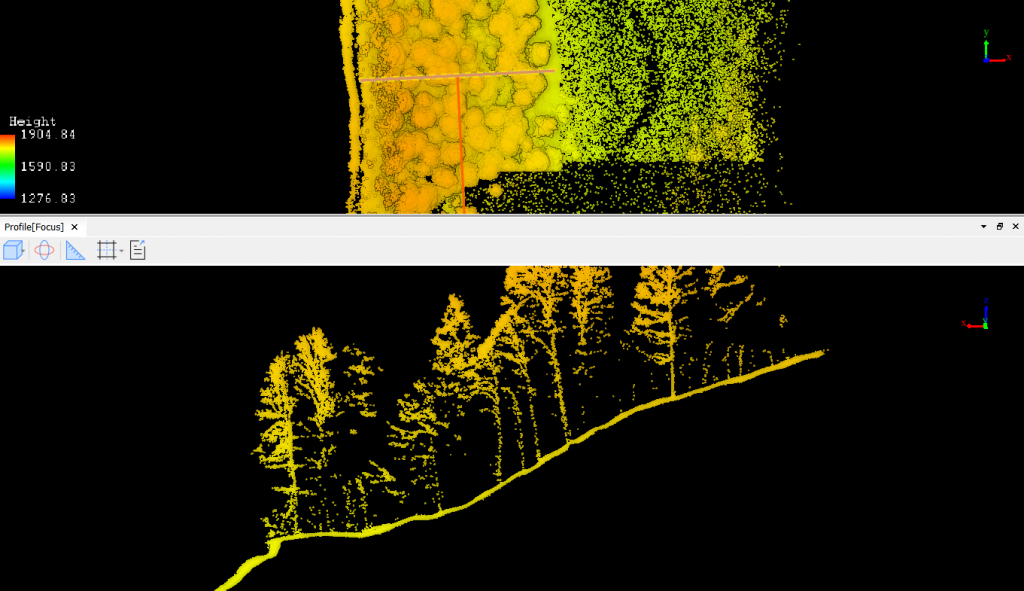
Pic. 20. Forestry surface profile.
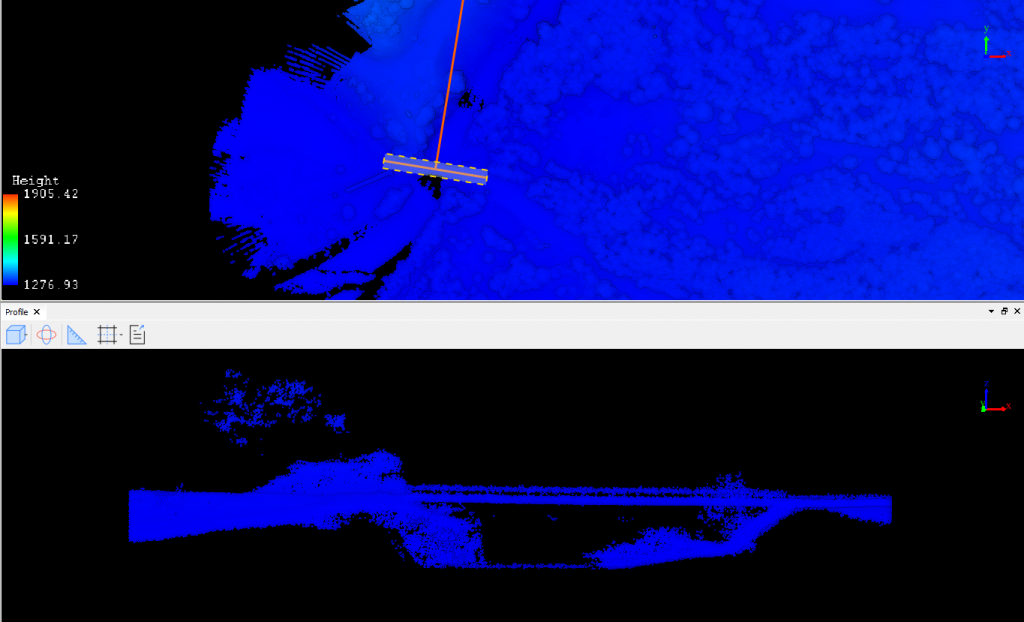
Pic. 21. River bridge.
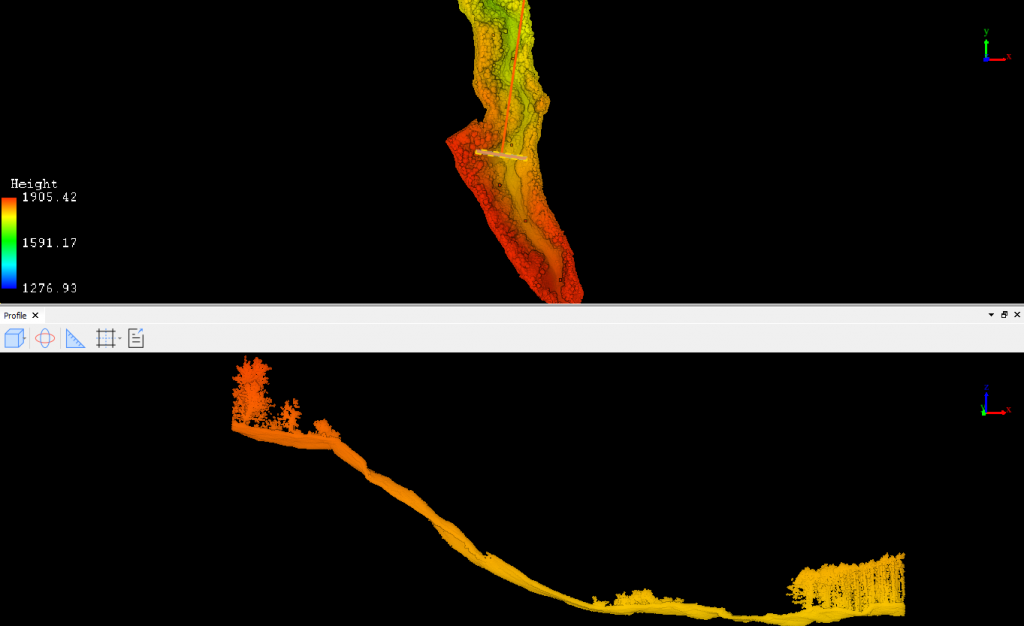
Pic. 22. Gorge profile.
Next step is classification of the point cloud and the main task is to get the proper Ground Layer.
Using the “Classify Ground Points” function we get an extracted surface layer from the whole point cloud, without vegetation, buildings and etc. To be sure that Ground Layer doesn’t contain other points we need to produce DEM and check the cloud using Profile View.
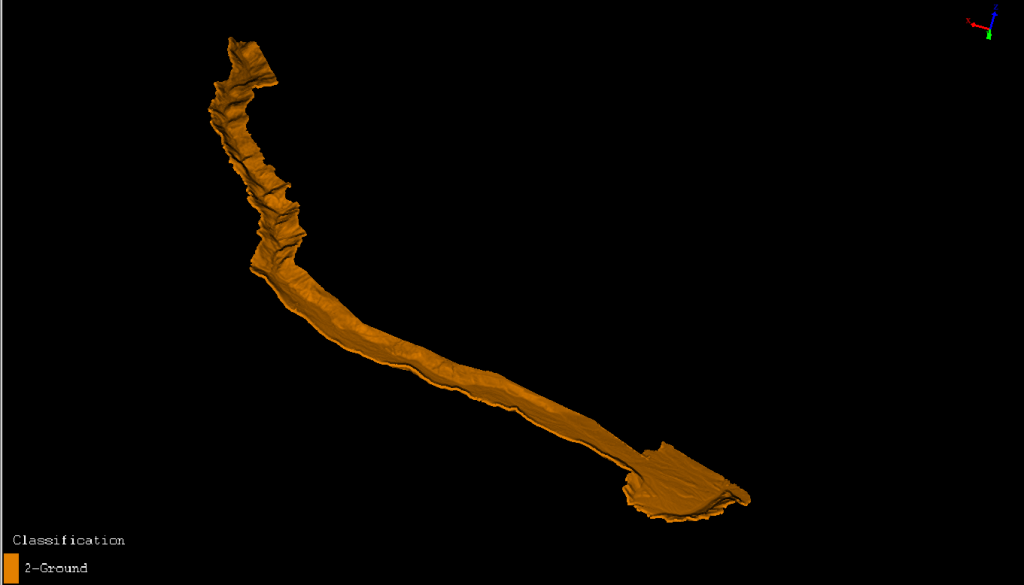
Pic. 23. Ground Layer.
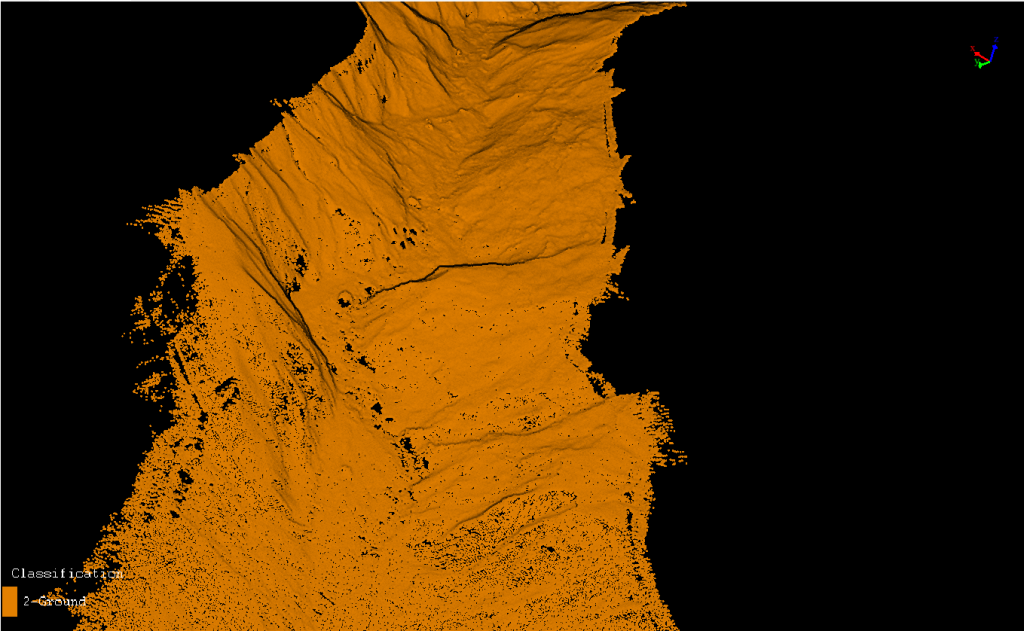
Pic. 24. Ground Layer.
After we got a proper surface layer, it is possible to generate the surface contour lines.
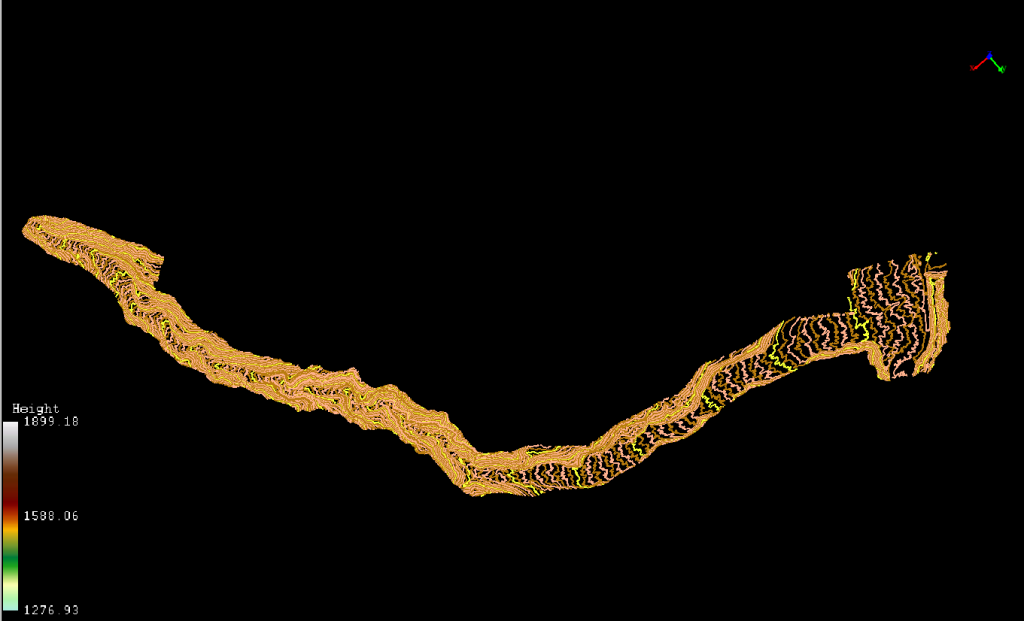
Pic. 25. Contour lines.
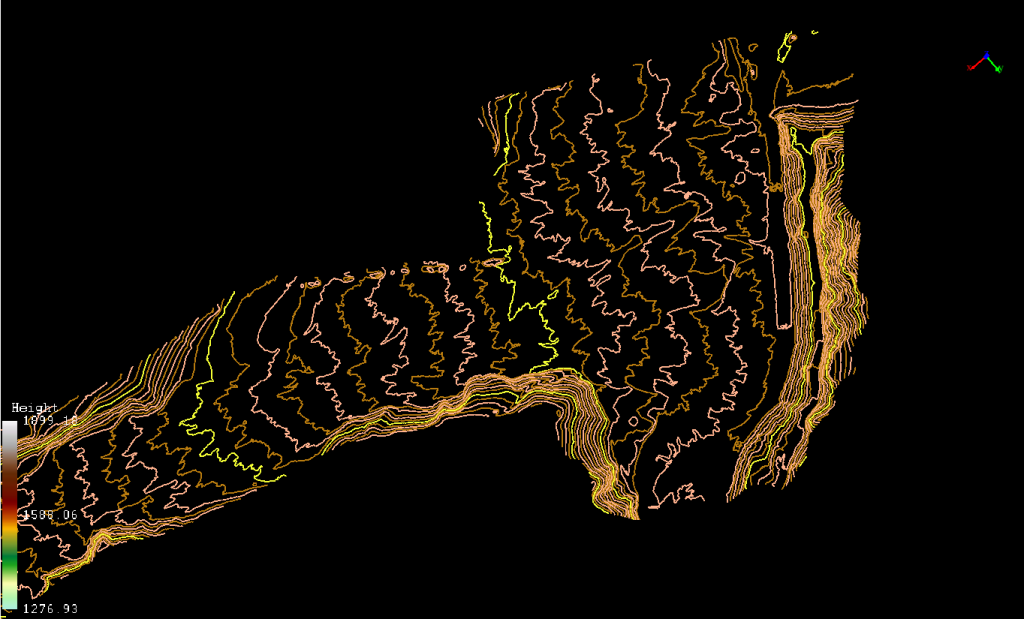
Pic. 26. Contour lines.
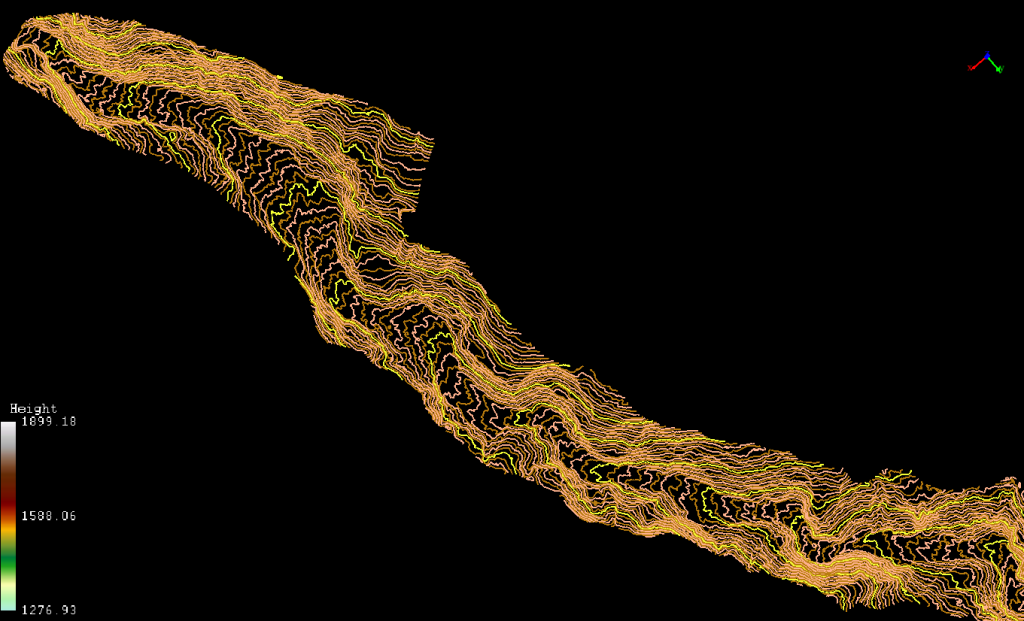
Pic. 27. Contour lines.
Conclusion
Project results:
- The survey of a section with a length – 6 km, corridor width – 200 m and a total area of 120 ha, was completed in one day.
- The operation of the equipment in conditions of a large heights difference, difficult terrain, loss of communication between the drone and R/C and the absence of the Internet is absolutely fault-tolerant.
- Processing and preparation of received data took 3 working days.
- The accuracy has been confirmed.
All data has been verified and accepted by the Contractor. At the moment the project is completed.